Authenticity vs. Purism

Infighting in the “animal rights” movement

(Original article publication date:  August 17th, 2012 (Cruelty-Free))

As most of us have, unfortunately, been forced to admit, the animal protection community is rife with infighting.  For some time, I’ve been unable to understand why people who are theoretically working for similar—if not identical—goals would be so openly hostile and defamatory toward others.

Some potential explanations are beginning to surface, though.  For instance, one part of the problem seems to be a struggle between authenticity and purism.

Authenticity

When a person behaves with authenticity, he or she stays in touch with the values that brought him or her to the animal protection cause in the first place. The compassion, empathy, and reasoning that originally connected the person to other animals remains intact and pervades his or her daily actions and interactions with others.

In this place of centeredness, a person’s ego is subordinated to both the outer goal of changing society’s treatment of animals and the inner walk of simply being a living embodiment of these values.  The ego’s desires for beating others, being right, taking credit, gaining adoration, controlling others, and acquiring power are seen as counterproductive with respect to the outer goal and disruptive with respect to the inner walk.

Purism

When a person in the animal protection movement fixates on purity itself, the entire focus shifts away from the goal and the walk.  The new focus becomes a game of competing for who can be “more pure” than others in the movement (“I’ve been vegan longer than you,” etc.).

Control and credit are the “rewards” for winning the game, and these rewards may accrue to the benefit of a given individual.  But the movement itself loses, because the goal of societal change gets forgotten in the never-ending power struggle, and the inner walk of being the change is abandoned in favor of self-serving calculations and maneuvers.

Awesome rabbit pic by Vanessa Sheldon

School violence

(Original article publication date:  June 26th, 2012 (Cruelty-Free))

Normalization of and indoctrination into the culture of violence

Every day at lunchtime, another generation of school children—from small country schools to big city ones—is gradually indoctrinated into a culture of violence.

Not only are school kids served the dead body parts of brutalized cows, pigs, chickens, and others, but these children are taught to be thankful for the products of unmitigated violence.  Truly, no Nazi propagandist could rival the animal-killing industry’s skill.

So long as schools are not vegan, schools will be a primary mechanism through which violence is cultivated and perpetuated in our modern society.

Cruelty-Free
Cruelty-Free

—30—

Comment, 2016:  Humane education is the antidote to and the philosophical opposite of the violence-inclusive educational approach that our schools currently embrace.  Eventually, we won’t need to call it “humane education”, though; inethicacy will be regarded as a basic problem of education, just as illiteracy and innumeracy are regarded now.


Dramactivism

Exhibitionism vs. action

(Original article publication date:  June 24th, 2012 (Cruelty-Free))

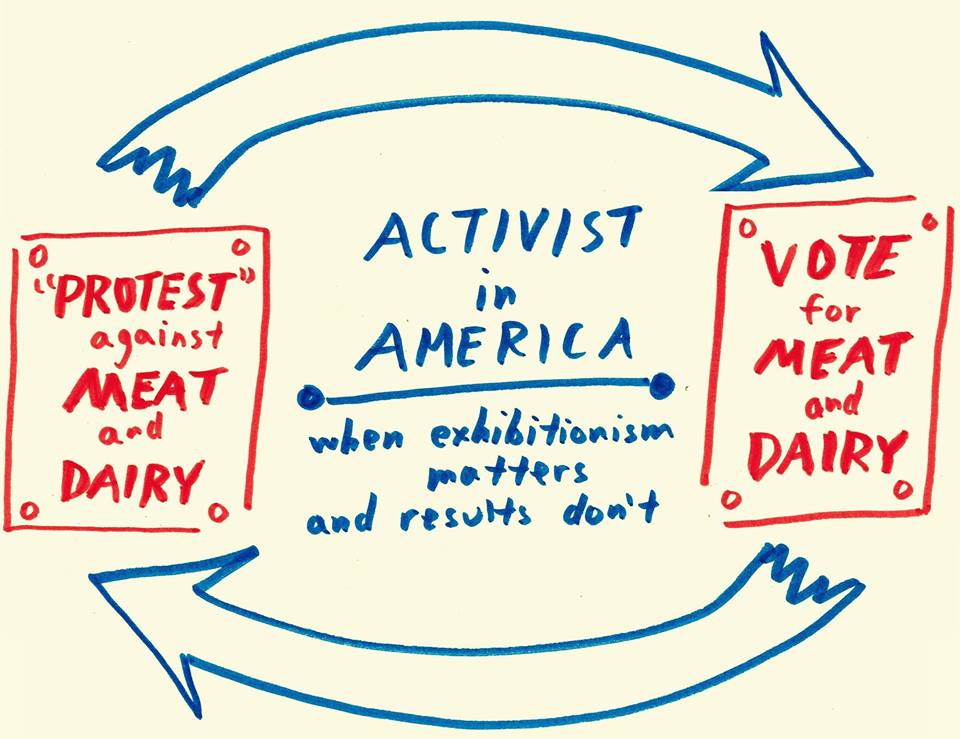
What would happen if all the time that Americans spend complaining were, instead, spent working for change?

Thousands of people will show up for a protest without even knowing what’s being protested. (Just listen to the protesters being interviewed.) But organizations actually working for change can hardly find a single volunteer to do real work.

I’m going to start using the term “dramactivists” so as to distinguish activists working for change from exhibitionists working for attention and public adoration.

Exhibitionism
Exhibitionism

The “no-kill” myth

When good intentions become decoupled from veganism: the “no-kill” myth

(Original article publication date:  June 23, 2012 (Cruelty-Free))

For each cat or dog that you rescue but do not take vegan, you condemn dozens of animals per year to death, namely, the cows, pigs, turkeys, and others who are raped, tortured, and killed to become that cat’s or that dog’s meal. Each of these condemned beings is just as smart, just as loving, and just as worthy of protection as the one for whom you brutalized and killed them.

That’s why the so-called “No Kill” movement—when not coupled with veganism—produces an exponential acceleration of the killing.  One life saved produces, say, 24 killed.  It’s a meat industry bonanza.

And one of the most extreme perversions of people’s good intentions that modern culture has to offer, since its effect is the exact opposite of “No Kill.”

I advocate calling it the “Rape-and-Kill” movement or the “Over-Kill” movement so that people can at least go in with open eyes. Very few things are scarier than wholesale, unmitigated savagery in the name of good.

No-Kill Myth
No-Kill Myth

The “Rage to Master”

The Development of Mastery

Psychologists report that some children have an innate, self-driven desire to learn and know all there is to know about a field.  These children lock onto and pursue a topic with unusual tenacity, pouring hours of unbroken concentration into exploring this topic.  The results of this kind of concentration are not surprising:  a very high competency in the chosen field.

One phrase that is apparently in current usage as a label for this type of drive is the “rage to master.”

Not Just for Kids

While “child prodigies” appear to have attracted the most study so far, the “rage to master” is not something that is unique to children—or child prodigies.  College and law students can also catch fire with an internal desire to know, dominate, master a field.  These students are, of course, great at test preparation.

Finding the “rage to master” within oneself for a topic such as the logical reasoning or reading comprehension that is tested on the LSAT or the contracts, torts, evidence, or other law topics that are tested on the bar exam may require some soul-searching.  But it’s worth going on this journey, because that fire—the rage to master—is an incredibly powerful mechanism for improvement.  More discussion on the rage to master coming soon. .


(Original publication date:  August 23, 2011 (LEX))

Even More about First-Year Law Outlines

The Upside

While there is a great deal of downside to the “outline obsession” that tends to overtake first-year (1L) law school students, outlining one’s first-year topics—property, constitutional law, civil procedure, and the lot—can be beneficial.  Potential benefits from first-year law outlines include:

_____________________

 — enhanced memorization / recall of the law:  the outline can be used to help students memorize rule statements; this possibility is, of course, the main theoretical justification for making an outline at all
— increased understanding of the law:  the outline—specifically, the process of making an outline—can facilitate a person’s delving deeper into the subject matter; this possibility represents the best opportunity of all to make outlining worthwhile
— it’s something to do:  the outline can become a sort of “lightning rod” that attracts the attention of a student who would otherwise have difficulty concentrating / studying
— anxiety reduction:  some students find that, by working on their outlines, they feel more “in control” of there first-year of law school and therefore less anxious about it

_____________________

Effective Engagement—Not the Outline Itself—Is the Real Reason to Outline

Notice that all of the above possible benefits to law outlining pertain to the effect of the outline on the student, not the value of the finished product itself.  After all, as previously discussed, law students are not in the law publishing business, so a student’s outline will probably never be used again once the final exam ends.

But achieving these desirable effects does not necessarily follow from merely doing an outline.  These effects flow from effectively engaging in the process of outlining.

This effective engagement is, in short, the key to making one’s outline efforts worthwhile. Effectively engaging in the outlining process—and the learning process generally—will be the topic of upcoming articles.


(Original publication date:  August 18, 2011 (LEX))

More on First-Year Outlines

The Downside

If outlines on the major first-year topics—contracts, torts, criminal law, and so on—were dependably useful, “obsession” would not be the right word to describe the extensive efforts that many first-year (1L) law school students pour into their law school outlines.  Unfortunately, for most students, the word is appropriate.

Here are some of the reasons.  These reasons are, of course, no secret to anyone, but students often lose sight of these facts during the rush of first year.

_____________________

— you get no points and no course credit whatsoever for your outline
— you are not in the publishing business and probably won’t ever be
— you can create a 100-page outline and still have virtually no understanding of the law
— if you are not allowed to use materials such as your outline during the exam for the given subject, then you won’t even have your outline physically available to you when you need it
— those students who are allowed to use their outlines during an exam generally report that they never actually did use their outlines during the exam because outlines don’t really help one’s analysis of or writing about an issue

_____________________

Consider Your Goals

In light of the above, the amount of time and effort that goes into the production of extensive first-year outlines is often a bad investment.  Certainly, at least a few students do benefit from their outlines, but, as will be discussed in an upcoming article, there’s usually a lot more going on than mere production of an outline when the outline endeavor actually pays off.

Thus, students are advised to consider what their real goals are—learning and understanding the law, succeeding in law school, for instance—before they choose to invest a large portion of their first semester and first year of law school in outlining.


Original publication date:  August 17, 2011 (LEX))