Preface: This article is the second installment in a series discussing obstacles to abolition—the ending of all slavery—that movements for proto-abolition—the ending of human slavery—did not have to face.
Collective resistance
Another significant difference between ending human slavery and ending slavery of other animals pertains to collective resistance, armed revolt, and organized rebellion: when humans are slaves, the potential for an armed, organized slave uprising is present at virtually all times. This threat puts pressure on the oppressor class, forcing them to spend a significant portion of their resources on precautionary measures to guard against a revolt. In short, the “slave front” drains the oppressor’s resources in its war against the slaves. Moreover, actual slave uprisings, e.g., Nat Turner’s Rebellion (the “Southampton Insurrection”) (1831), sometimes break out despite the oppressors’ safeguards, inflicting damage directly upon the slaveholder class, their persons and their property.
Unfortunately, however, a full abolition movement can expect to receive very little assistance from the slave front. The possibility of, for example, laboratory rats organizing a coordinated, armed, violent uprising is virtually non-existent. The same goes for, say, farmed animals who are slated for slaughter: a collective revolt comprising sheep or cows or chickens is just very unlikely.
Yes, occasional acts of individual heroism do occur, as in the case of a lion or tiger who kills a circus trainer. But collective, sustained revolt from within the slave class will not happen. To my knowledge, only primates and elephants have been documented to engage in substantial, coordinated retaliatory action against homo sapiens.
That a full abolition movement cannot expect to benefit from help of the slaves themselves does not itself, of course, render abolition impossible. We will win. But it is helpful to appreciate that the challenges facing a full abolition movement are substantially larger than those that have been surmounted by proto-abolition movements and that some of the resources with which to meet those challenges are not as readily available to a full abolition movement.
A look ahead…
In this “Special Challenges” series, we’ll explore additional ways in which proto-abolition or proto-emancipation movements differ from abolition and emancipation movements. If you have comments, suggestions, or contributions, please feel free to send them along.
Preface: This article is the first in a series of articles discussing obstacles to abolition—the ending of all slavery—that movements for proto-abolition—the ending of human slavery—did not have to face.
The virtuous cycle
One significant difference between ending human slavery and ending slavery of other animals pertains to what may be called a “virtuous cycle”: when a human slave is freed, he or she becomes part of the anti-slavery movement. The former slave can take up arms—literally or figuratively—against the enslavement of other humans. Thus, a proto-abolition movement accelerates with each and every successful freeing of an individual.
That virtuous feedback cycle does not, unfortunately, happen when slaves of other species are freed. For instance, when a cat is rescued from a vivisection lab, that cat is not going to pick up a pen or a sword to help free other cats from torture.
This distinction is but one of the many reasons why the movement to end slavery—meaning, all slavery—faces numerous challenges not faced by movements that were directed at ending human slavery only. We’ll win anyway, but it’s important to understand that simply repeating what proto-abolition movements did will not likely suffice for full abolition.
A look ahead…
In this “Special Challenges” series, we’ll explore additional ways in which proto-abolition or proto-emancipation movements differ from abolition and emancipation movements. If you have comments, suggestions, or contributions, please feel free to send them along.
(Original article publication date: June 24th, 2012 (Cruelty-Free))
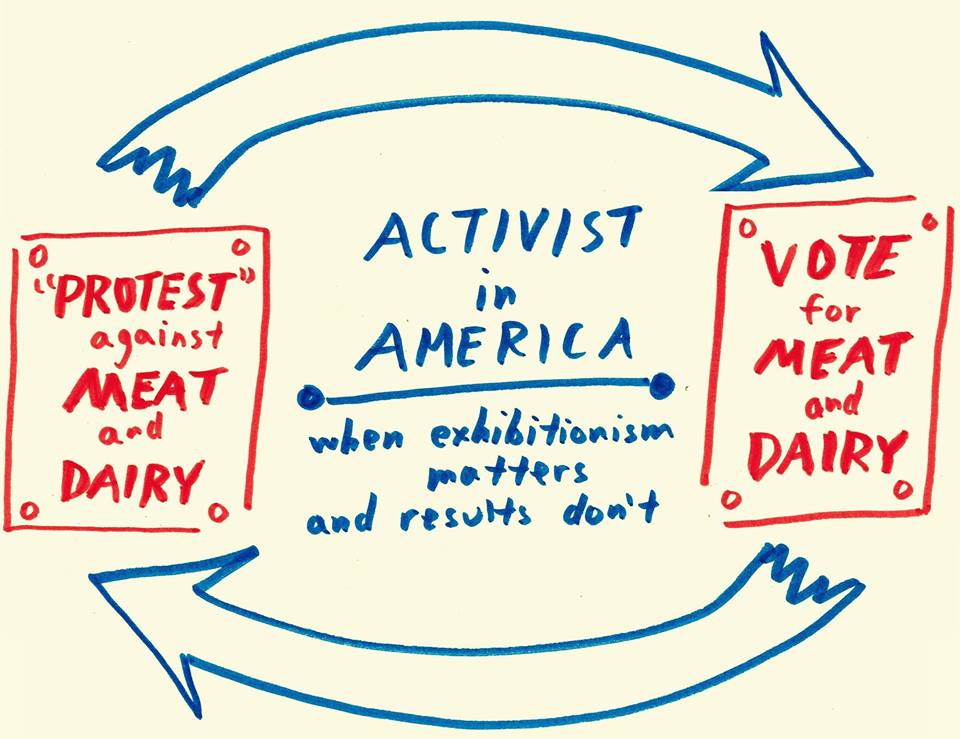
What would happen if all the time that Americans spend complaining were, instead, spent working for change?
Thousands of people will show up for a protest without even knowing what’s being protested. (Just listen to the protesters being interviewed.) But organizations actually working for change can hardly find a single volunteer to do real work.
I’m going to start using the term “dramactivists” so as to distinguish activists working for change from exhibitionists working for attention and public adoration.
When good intentions become decoupled from veganism: the “no-kill” myth
(Original article publication date: June 23, 2012 (Cruelty-Free))
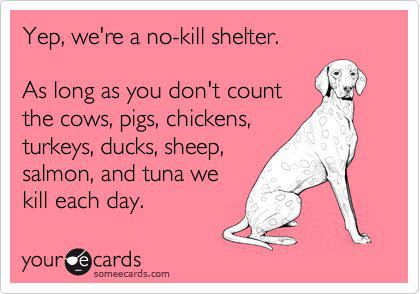
For each cat or dog that you rescue but do not take vegan, you condemn dozens of animals per year to death, namely, the cows, pigs, turkeys, and others who are raped, tortured, and killed to become that cat’s or that dog’s meal. Each of these condemned beings is just as smart, just as loving, and just as worthy of protection as the one for whom you brutalized and killed them.
That’s why the so-called “No Kill” movement—when not coupled with veganism—produces an exponential acceleration of the killing. One life saved produces, say, 24 killed. It’s a meat industry bonanza.
And one of the most extreme perversions of people’s good intentions that modern culture has to offer, since its effect is the exact opposite of “No Kill.”
I advocate calling it the “Rape-and-Kill” movement or the “Over-Kill” movement so that people can at least go in with open eyes. Very few things are scarier than wholesale, unmitigated savagery in the name of good.
DAPC: Enforcing Cruelty Laws against Vivisectionists
(Original article publication date: May 7, 2011 (Cruelty-Free))
When most people see animals being tortured, they recoil in horror. But vivisection has nonetheless survived through the massive dollars and influence that universities, pharmaceutical companies, and medical lobbying groups wield.
In an effort to rally resources to stop animal torture, here’s a proposed acronym: DAPC.
DAPC stands for “Delicense, Arrest, Prosecute and Convict.” These are basically the four steps that need to be taken to eliminate vivisection. Specifically, “doctors” who torture animals must be stripped of their medical licenses. Obviously, torture is not part of the healing profession and is fundamentally contrary to the vows to which legitimate medical professionals adhere. Those who commit vivisection must then be arrested, prosecuted, and convicted for felony animal abuse.
Thus, the project in whole would be called “DAPC: Vivisection.” Just a thought. Here’s a little graphic that you are free to use for any anti-vivisection purpose.
I’m departing from the usual topic for this column to provide a review of a conference I attended on Friday, April 24, 2009.
Hosted at the Fish Interfaith Center of Chapman University, the event was entitled “Do Unto Others . . . A Conference on Animals and Religion”. This conference—the first of its kind in Southern California—was put together by a group of scholars who have taken on the name of “Interreligious Voices for Animal Compassion” (or just “IVAC”), including Zandra Wagoner, Beth A. Johnson, and Ronald L. Farmer.
The conference was a wonderful experience, and I sincerely hope that this one will be the beginning of an annual (at a minimum) tradition.
Some Highlights
The facility itself, particularly Wallace All Faiths Chapel, was certainly conducive to the kind of thoughtful discussion and contemplation that the day provided. Beginning at 9:00am, this hall was filled with wonderful harp music that began the day and was interspersed between speakers for the first hour.
Introductory speakers provided some background regarding how the conference came about as well as quotes and a series of personal statements pertaining to animals in the context of spirituality. These speakers were followed by a first keynote speaker, Jay McDaniel, Director for the Steel Center for the Study of Religion and Philosophy at Hendrix College in Arkansas and author of numerous books, including the classicOf God and Pelicans: A Theology of Reverence for Life.
Jay’s talk not only set forth a number of powerful intellectual insights regarding animals and how they are viewed in the world’s major religions but also allowed glimpses into his personal experiences related to animals and how these experiences have shaped his own world view of the value of life. Jay has a knack for being able to address high philosophy and self-effacing humor simultaneously, which made his presentation a delight that went by too quickly.
Beth Johnson and Jay McDaniel prepare for a vegan dinner.
In between the morning events, participants mingled with representatives from a number of different animal-related organizations, including Animal Acres founder and Farm Sanctuary pioneer Lorri Houston
.
Shelley Harrison and Lorrie Houston take a break between sessions.
The Christian Vegetarian Assocation had a display providing a wide variety of literature, as did Peta, and the conference organizers also provided display copies of about forty key books in the field.
After breaking for a vegan lunch, conference-goers chose two out of six different one-hour workshops to attend consecutively during the afternoon. I personally attended a session called “Inside the Trenches: An Evangelical Looks at Animal Compassion,” which was led by Presbyterian Minister Reverend Mark Bruner, and “Schweitzer and the Animals”, which was led by Dr. Marvin Meyer, Chair of the Religious Studies Department and Director of the Albert Schweitzer Institute at Chapman. Both sessions were excellent, and I wished I had been able to attend all six.
Thereafter, the conference reconvened as a single group for a panel discussion featuring McDaniel, Johnson and Wagoner. This portion was one of my favorite parts of the day, since the flexibility of the format allowed for a great deal of spontaneous discussion and Q&A between the conference-goers and featured speakers.
That evening, we all gathered for a vegan feast in a different location on the Chapman campus. The dinner was fabulous, and I thoroughly enjoyed getting to meet the people at my table. We shared light-hearted stories regarding being vegan in a world that eats dead animals as well as discussed strategies on how to get the word out about the pervasive cruelty in our culture. I found it encouraging and uplifting to be around like-minded folks.
Batting clean-up hitter for the day was the vivacious Karen Dawn, author ofThanking the Monkey: Rethinking the Way We Treat Animals, which has received numerous accolades, including that of being among the “Best Books of the Year” according to the Washington Post. Like Jay, Karen is somehow able to discuss grave–and sometimes heartbreaking–matters and yet remain fun, witty and charming while doing it.
Karen Dawn discusses her fowl friends at the evening banquet.
Overall, the event was a smashing success. I hope there are many more to follow.
In 2007, theNew York Times, NPR, and other media reported the discovery of a photo album containing what I consider to be the most gruesome photographs from all of the Second World War. But these photos do not depict a single dead or wounded body. They are far more ghastly even than that.
The album belonged to SS officer Karl Hocker, who was assigned to Auschwitz from May 1944 until liberation of the camp by the Allies. The photos show SS guards and their friends frolicking, flirting, decorating Christmas trees—engaging in all manner of activities that a seemingly “normal” human being would do. And all this took place in the shadow of—or in some cases within the actual walls of—a death camp in which these very same frolickers were daily murdering other human beings by the thousands.
Take a moment to recreate the context of these photographs. A man gets up in the morning, has breakfast, kisses his wife, gives the kids a hug, pets the dog on the head, and goes to work—gassing and cooking people to death, that is.
The Banality of Evil
Hannah Arendt (1906-1975) grasped the general notion as “the banality of evil” in her breakthrough 1963 workEichmann in Jerusalem: A Report on the Banality of Evil. She argued persuasively and influentially that the greatest evils in history, such as the Holocaust, have been perpetrated not by sociopathic demons but by seemingly normal people who engaged unthinkingly in atrocities that were assigned to them by authority figures. The 1961 Milgram experiment at Yale and the 1971 Stanford prison experiment both appeared to reproduce a similar effect.
Compartmentalization: The Walls of Evil
Even if it is true that otherwise normal people—from Auschwitz to Stanford—can be relatively easily influenced to commit gargantuan acts of evil, the question to me that remains is simply this: how is such a phenomenon possible at the psychological level? How did bank teller, husband and father Karl Hocker make the daily transition from these other roles to that of aiding and abetting mass murder?
I think the answer lies in the psychological notion of “compartmentalization”. Compartmentalization denotes the process whereby human minds engage in a form of what logicians call “confirmation bias”. The gist of it is this: we tend to ignore, forget or “wall off” evidence that conflicts with our current views of ourselves.
For someone like Karl Hocker, compartmentalization allowed him to (i) accept evidence that reinforced the view of himself himself as a loving, competent bank teller, community member, Christmas tree decorator and family man and (ii) simultaneously ignore overwhelming evidence that he and his SS friends were completely psychopathic, serial-killing monsters. This is confirmation bias at its best (or worst).
In short, rather than integrate information and accept disconfirming evidence, the person who engages in compartmentalization can live essentially two distinct, disintegrated lives. Such a person is never forced to deal with the crisis of conscience that an integrated person would certainly face.
Compartmentalization is the wall that allows evil to run free within the mind of an otherwise seemingly healthy individual.
Pro-Survival Trait
If compartmentalization is indeed the grand enabler of evil, the question remains how compartmentalization ever evolved in the first place, since mass murder of one’s neighbors would seem to be a trait that would get an individual quickly weeded out of the gene pool.
Upon close inspection, however, the positive effects of compartmentalization are not hard to identify. We are all fallible human beings, and each of us endures a large number of losses, setbacks, and injuries in our lives. If we were unable to set these things aside—ignore them, at least for a while—and move on, we would all eventually curl up in a fetal position and just waste away. Our first failure at something would be the last time we ever tried to succeed at anything. Our first romance-gone-bad would be the last relationship we ever undertook. Our first loss on the baseball field would be the last game we ever played.
Walling off information that would hurt or destroy one’s sense of positive self-worth can thus be seen generally as a pro-survival trait. Only problem is that this trait, like many other pro-survival traits, may also have dire negative side effects.
Unthinking commission of mass murder probably qualifies as a negative side effect. . . .
The Most Gruesome Photo Album of the Next Century—Starring You
There’s just one more little thing to cover in this article. It’s a photo album that will be discovered and printed in theNew York Timesin the year 2109. And it’s the most gruesome photo album anyone has seen since that of Karl Hocker.
Interesting thing about this album: just like Hocker’s, there’s no blood. No gore. No death nor even injury depicted. The photos just depict a happy family person who wakes up, kisses the spouse, hugs the kids, pets the dog, and heads off to work. This normal person in the photo album passes a slaughterhouse on the way to work, inside of which thousands of innocent, sensitive and intelligent pigs are being killed everyday. The star of the photo album never once thinks twice at lunch as he or she eats a piece of bacon.
Technological breakthroughs can pave the way to major social changes—some good, some bad, some mixed. The internal combustion engine and other automobile advances, for instance, enabled numerous positive services, such as ambulances and fire engines. But the automobile also gave rise to city designs and lifestyle choices that are inefficient to the point of being almost bizarre, as in the now-common case of a freeway commuter who drives an hour or more—each way—to and from work.
In more recent years, the World Wide Web has again demonstrated that technological advances can precipitate fundamental changes in the ways that people work, play, shop, and socialize: the telecommuter is gradually replacing the freeway commuter, and MySpace and Facebook have emerged as primary ways to “hang out”.
The Impervious Dinner Plate
While computers and mobile electronics continue to revolutionize many other aspects of life, people’s eating habits have been very slow to change. Folks who ate bacon and eggs for breakfast, hamburger and fries for lunch, and pizza and beer for dinner 30 years ago are still eating those same items today. Aside from some packaging updates, the menus of restaurants that were in business 30 years ago, such as McDonald’s or Pizza Hut, remain little changed today.
Perhaps dietary habits are so deeply rooted in a person’s consciousness that they become a part of one’s identity. Certainly many community and religious events and holidays, such as Thanksgiving and Christmas, revolve around food. But whatever the reason, dietary choices have remained relatively impervious to the wave of change that has swept over many other personal choices in recent decades.
The Cost of Consistency
Unfortunately, the dominant eating habits of Western culture have proven to be wildly destructive at the environmental level. Meat, in particular, extracts a devastating toll, as it is a profoundly inefficient food item. Specifically, it generally takes approximately 10 to 25 times—that’s 2500% —more resources to produce a pound of meat than to produce a pound of vegetable food. After all, animals must either eat other animals or eat plants, whereas plants simply get their sustenance from the sun and the soil. Animals also require medicine, lodging and other upkeep, whereas plants are relatively very low maintenance. Finally, animals used for meat production expel a great deal of polluting gases, such as methane, whereas plants generally had an unequivocally beneficial effect on the environment.
The net effect of consistency in the dominant Western diet has therefore been highly negative. Indeed, many environmental scientists now consider meat to be the single most environmentally harmful modern lifestyle choice—yes, even worse than driving a gas guzzler.
And that’s not even to mention the well-documented health effects, from heart disease to obesity, of the Western and particularly American diet.
Meat Substitutes: a Good Start
Soy burgers and other vegetable-based meat substitutes (sometimes called “meat analogues”) have taken root in many households. Tofu has proven to be a sort of “miracle meat” in that it can take on so many flavors that even discriminating meat lovers can be fooled by tofu products masquerading as meat. These culinary advances have been applauded by environmentalists, nutritionists and animal rights activists alike.
But, while the personal health and environmental benefits of a vegetarian diet have been thoroughly demonstrated, whether meat substitutes can ever overtake the Whopper and the Quarter Pounder with Cheese remains to be seen.
Enter Artificial Meat
Perhaps meat substitutes do not have to replace real meat in order for many of the detrimental effects of meat production to be avoided. Scientists have now demonstrated the ability to produce actual meat—not a vegetable substitute—using cell cultures rather than cows, pigs, or sheep. Specifically, certain cell samples originally taken from an animal are then nourished and cultivated to proliferate into large quantities of such cells, thereby producing artificial meat (also “in vitro”, “synthetic” or “test tube” meat) that is at the cellular level essentially identical to meat that comes from the muscles of slaughtered animals.
Implications, Pro and Con
Many hurdles are yet to be overcome before artificial meat can fully replace slaughter-based meat. First, the in vitro technique is still too costly to compete with slaughter for meat production in the mass market. However, over time, these costs may come down, especially if a handful of early adopters are willing to pay a premium for cruelty-free meat.
Second, cell cultivation may not sound particularly appealing to a society that is accustomed to the use of farm animals to produce food. Test-tube meat may sound very “sci-fi”, mysterious, and perhaps even dangerous to the average consumer. Of course, such a perception is just that, a perception, and can probably be changed when met head-on with informational measures, such as those suggested by M. Renee Orth inher article on legislation for public surveillance of the slaughter industry.
Third, even in vitro meat is likely to prove highly wasteful of resources compared to vegetable food. While not as wasteful as traditional meat production, the new technique will still have significant, inherent overhead costs, and the conversion of organic material to meat will probably always be less efficient than a food production system that requires no such conversion.
Fourth, to the degree that synthetic meat fully replicates slaughter-produced meat, the massive health benefits of a vegetarian diet are lost.
Fifth, purists in the fields of environmentalism and animal rights activism may view artificial meat as a way of actually prolonging the meat addiction of modern culture and thereby undermining efforts to bring about true sustainability and cruelty-free living. Under this view, switching from slaughter-based meat to artificial meat is the equivalent of switching an alcoholic from wine to beer. However, if artificial meat does in fact significantly reduce the demand for slaughter-based meat, the purist argument will probably fail, at least in the animal rights field. Net environmental impact will be more difficult to resolve.
Opportunity for Long-Overdue Dietary Shifts
Notwithstanding the above reasons for caution, artificial meat has at least the potential to be a disruptive technology, one that could bring about fundamental changes in a sphere that has heretofore remained relatively impervious to change: what’s for dinner. Executed properly, artificial meat production could (i) dramatically curtail the practice of animal slaughter and thereby (ii) bring about a significant reduction of the environmental harms inherent in raising animals for slaughter. These two effects make the technology highly desirable and worthy of pursuit.
(Original pub date: March 30th, 2009 (Cruelty-Free))
In the good old days of torture, “religion”* served as the ultimate justifier. During the Spanish Inquisition or the Salem Witch Trials, for instance, one could make a hobby or career of slowly crushing people with rocks or burning people at the stake. And the perpetrator of these acts could still be considered a righteous person for doing so, because these atrocities were done in the name of God. During such time periods, both professionals (such as clergy) and amateurs (such as the girls who provided most of the Salem witch accusations) could be grouped into two basic camps: (i) those who actually believed that torture served a legitimate end, and (ii) those who used “religion” simply as an excuse to indulge their sadistic fantasies.
While the moral culpability or blameworthiness of the second group might be higher, the end results produced by both groups were the same: bloodcurdling and gruesome torture and death of innocent victims. It is, therefore, difficult to completely absolve the first group simply on the basis of their ignorance.
Fortunately, numerous political principles (e.g., separation of church and state) and legal principles (e.g., presumption of innocence) have come along to largely eliminate the power of “religion” to serve as justification for sadistic indulgences, at least in Western culture. Unfortunately, however, a substitute justification has stepped in to fill the void left by religion.
The new justification for torture is called “science”*. But, in order to avoid the human rights obstacles that dethroned torture-as-religion, torture-as-science has been directed at animals.
Torture as Science
In modern times, the sadist’s refuge is a university or commercial lab, not a church. Safe within these walls, a “scientist” can inflict unspeakable horrors upon innocent victims day after day, out of sight and out of earshot of any (human) witness, and free from any authority who can intervene to halt the suffering. Victims are poisoned, shot in the face, burned alive, dissected alive and otherwise tortured in ways that would make even the most perverted inquisitor bow in awe. These very same acts would be criminal felonies if committed by a layperson—such as rape or beating of an animal—, but they are allowed to go unpunished as long as the perpetrator is wearing a lab coat. Indeed, the perpetrator—generally equipped with doctoral degree—is often revered as a truth-seeker and lover of knowledge. Meanwhile, death is literally the best and only hope for laboratory animals.
As with “religion” torturers, “science” torturers fall into the above two groups: (i) those who actually believe that torture serves a legitimate end, and (ii) those who use “science” simply as an excuse to indulge their sadistic fantasies. People falling into the latter group don’t merit any lengthy discussion. They are sick perverts who share the same common trait that serial killers typically share: a desire to torture defenseless animals.
“Scientists” falling into the former group do require more discussion. These are people who have been taught that science is a sort of unqualified good, an end that justifies any means. This point of view has been discredited long ago in the realm of philosophy. But, unfortunately, the Philosophy Department and the Science Department don’t yet communicate with each other very well on some university campuses.
Accountability as Accounts Receivable
Hopefully one day, science will be subjected to the same ethical constraints that religion has been. We really cannot pretend to be civilized until such day comes.
But until then, there is one higher authority that even “science” torturers recognize: the Almighty Dollar. And the power of this Almighty can be tapped by people like you and me every day in order to bring some accountability to the otherwise unmitigated victimization of laboratory animals.
Specifically, we can choose to spend our dollars to purchaseonly those products that have never been tested on animals(other than human volunteers who have provided informed consent in writing and in advance) andonly those products that are made by companies that never engage in animal testing. In refusing to support torture-as-science, we can hope to starve animal abusers financially just as they starve their victims literally.
Buy Only Those Products That Display the “Leaping Bunny” Logo
One easy way to bring the wrath of the Almighty Dollar to bear upon animal abusers is to buy only those cosmetics, toiletries and household products that display the “Leaping Bunny” logo. This logo is applied only to products which have met strict, cruelty-free standards as certified by the Coalition for Consumer Information on Cosmetics (CCIC). Organizations making up the CCIC include: American Anti-Vivisection Society, The Humane Society of the United States, Animal Alliance of Canada, and European Coalition to End Animal Experiments.
The Leaping Bunny Logo
Disciplining ourselves to purchase only those items that display the “Leaping Bunny” logo serves two very important purposes: (i) it provides financial rewards to those companies that do practice ethical science, and (ii) it financially starves those companies that practice torture “science”. We want the former companies to prosper and the latter companies to perish.
One Final Thought
Somewhere out there, another helpless cat or rabbit or chimpanzee is being taken from her mother to be subjected to a life of terror, pain and despair. She will spend her remaining days immobilized in a head clamp while harmful chemicals are squirted into her eyes or her mouth or on her skin. The best we can hope for her is that the mercy of death comes quickly.
You and I have the power either to sponsor or reject torture. In honor of the latest nameless victim, take the “Leaping Bunny Pledge” to buy only cruelty-free products:http://www.leapingbunnypledge.org/pledge.aspx
*I have used quotation marks around the words “science” and “religion” throughout this article, where applicable, because I do not believe that torture has a place in actual science or religion.
(Original pub date: March 29th, 2009 (Cruelty-Free))






 Biographer
You must be logged in to post a comment.