A patent in the field of postal mail, shipping, fulfillment, delivery, and courier services has issued as U.S. Patent 7,617,112 for “Postal system, method and device”.
invention
U.S. Patent 7,599,938 for “Social news gathering, prioritizing, tagging, searching, and syndication method” issues
A patent in the field of social media has issued as U.S. Patent 7,599,938 for “Social news gathering, prioritizing, tagging, searching, and syndication method”.
U.S. Patent 7,525,877 for “Time display system, method and device” issues
A patent in the field of time, horology, clocks, and watches has issued as U.S. Patent 7,525,877 for “Time display system, method and device”.
U.S. Patent 7,470,244 for “Flexion-discouraging splint system, method and device” issues
A patent in the field of health care, physical therapy devices, braces, and splints related to carpal tunnel syndrome has issued as U.S. Patent 7,470,244 for “Flexion-discouraging splint system, method and device”.
Invention Code Name: Uncommon Law™
Snapshot: Uncommon Law™ Universal Judicial Opinion Entry Software Forces Judges to Be Logical
(Original article publication date: July 15, 2008 (Inventerprise))
Problem
Common law judicial opinions have no set form or style (except that they be in English), and they are required to meet no minimum standards for quality—or even validity. This free-form, free-wheeling approach to law evolved hundreds of years ago as an expedient measure in less-enlightened times. And it’s time for it to go.
Solution
Uncommon Law™ software eliminates the possibility of long-winded, unnecessary rambling (the lawyers tell us they call that “dicta”) and of fallacious reasoning as follows: a judge logs into the Uncommon Law website and enters the case number and other identifying information. He then enters conclusion and premise data that go to make up his argument into the proper field. As many fields as necessary can be used, but each entry should include only one premise or conclusion.
Result
In this way, the logical validity of a judicial opinion can be relatively easily reviewed for errors—perhaps even automatically reviewed for certain simple errors.
—30—
Comments: This PeopleChase database product is based on the Universal Judicial Opinion system.
Post moved
this post has moved.
U.S. Patent 7,343,339 for “Electronic bond and guaranty process and business method” issues
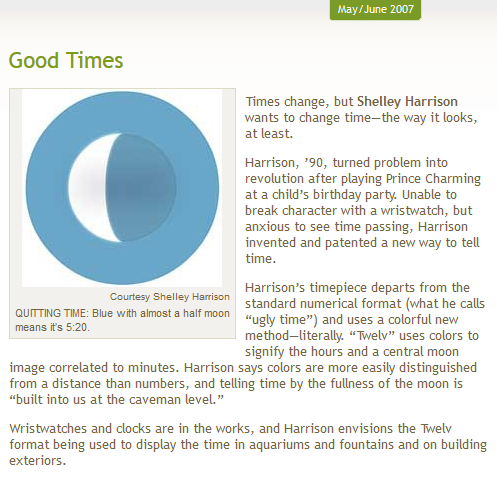
Stanford Magazine Reviews TWELV
Stanford Magazine has run a review of TWELV: The New Way to Tell Time.
U.S. Patent 7,221,624 for “Time display system, method and device” issues
A patent in the field of time, horology, clocks, and watches has issued as U.S. Patent 7,221,624 for “Time display system, method and device”.
Jatalla Goes to MIT
Summary: Less than two weeks after its groundbreaking search engine prototype was made publicly viewable, Jatalla has been invited to showcase in the Technology Review Emerging Technologies Conference 2006 at the Massachusetts Institute of Technology (MIT).
(Original article date: September 15, 2006 (PRWeb))
Less than two weeks after its groundbreaking prototype was made publicly viewable, the Jatalla search engine has been invited to showcase in the Technology Review Emerging Technologies Conference 2006 at the Massachusetts Institute of Technology (MIT). Jatalla was created by Los Angeles-based research and development firm Inventerprise LLC.
“We are honored and thrilled to be included in this event,” Inventerprise founder Shelley Harrison remarked. “It’s really a testament to the promise of user-generated, user-controlled content.”
Unlike conventional search engines, which rely upon automated webcrawlers and computer analysis, Jatalla provides search results derived from rankings performed by actual, living human beings. Through Jatalla, any World Wide Web user can cast a “lexivote”, which consists of two parts: (i) a word or phrase and (ii) at least one URL. Thereafter, when a search query is submitted, all lexivotes matching the search query are counted, and associated URLs are ranked according to the number of lexivotes they receive.
Vincent Caprio of Technology Review commented that he was also “honored” to have an innovation such as Jatalla represented at the conference, which is being held on September 27 – 28 at the MIT campus.
Search engine commentators have picked up on a number of unique features of Jatalla. One such feature is what the company calls “planned inefficiency.”
“Automation is increasingly the problem, not the solution, for technology users,” explains Harrison. “I don’t know anybody who enjoys being caught in an automated phone tree system talking to a voice-activated computer.”
“By the same token, the quality of search results generated by computers will remain far below that of search results generated by humans, at least as long as the latter are smarter than the former,” he continued. “That’s why every decision on Jatalla – such as whether or not to cast a lexivote on the plural form of a word – is made by an individual human user, inefficient as that may sound at first.”
The essential Lexivote system was created in 1999 in an ambitious but ultimately failing attempt to produce a 100% human-programmed “artificial conscience” called the “Ethicode.” Patent filings in 2003 and 2004 disclose not only the current Jatalla.com search engine but also numerous functions not yet deployed.
People who would like to try the new paradigm in search technology can visit http://www.jatalla.com and begin casting their own lexivotes.

 Biographer
You must be logged in to post a comment.