Inventor Patents New Way to Tell Time: Colorful Display Ideal for Cell Phones, Wearable Audio Players, and Mobile Electronic Devices

Summary:  A newly patented time-telling system—called “TWELV” —eliminates the use of numerals, clock hands and traditional clockfaces. Instead, each individual hour of the day is represented solely by one of twelve unique colors. The display is simultaneously more attractive and smaller in footprint than conventional time formats.

(Original press release:  LOS ANGELES, CA SEPTEMBER 14, 2006)

Inventerprise(R) LLC announced today the granting of a United States patent on a new way to tell time. The newly patented system breaks from centuries-old tradition, dispensing altogether with the use of any hour hand or hour digit. Instead, each individual hour of the day is represented solely by one of twelve unique colors.

As a result, the new time format—called “TWELV” —requires much less display monitor space than conventional formats. This smaller footprint makes TWELV ideal for use on mobile phones, portable consumer electronics, head-mounted displays, wrist-watches, and other wearable computing and communications devices.

“The prototype is stunningly simple and elegant,” a company representative commented. “Colors are not only more pleasing visually, but they can also be correctly recognized from much greater distances than can individual numerals or clock hands.”

In some TWELV embodiments, the minute hand or digit is also eliminated. Instead, a moon serves as the minute indicator, waxing from a slender crescent at the beginning of an hour to a full orb at the end. This embodiment also allows virtually any other monochromatic image —such as a company logo, a silhouette, or a musical note—to serve as the minute indicator.
Inventerprise arranged for designer Christopher Tjalsma to create the first prototype of the moon-based embodiment of TWELV. This prototype is now available for viewing via the web site: http://www.twelv.com.

“The sun and moon are probably the earliest time indicators used by the human race,” the representative continued. “Christopher’s design somehow taps into humanity at that very deep level. It feels a thousand generations old.”

The patent announcement comes on the heels of the company’s headline-making roll-out of Jatalla.com (http://www.jatalla.com), a prototype search engine that uses no Web crawlers and no document analysis software, instead relying solely upon relevancy rankings performed by living human beings.

Watches and clocks based on the TWELV(TM) system, including the Tjalsma Intuitime(TM) design and the hybrid TIKR(TM) design—which provides minute but no hour digits—are expected to be made available commercially in two to four years. All TWELV displays also include an override feature, allowing users to display time in standard 4-digit format if needed.

View the latest paradigm in horology at http://www.twelv.com.

TWELV | a new way to tell time

David vs. Goliath: Week One

Summary:  A prototype demonstrating new search engine paradigm survives its first week and demonstrates viability of user-determined relevancy rankings.

(Original article date:  September 5, 2006 (PRWeb))

Upstart search engine Jatalla.com, after rolling out a prototype of its unusual approach to relevancy ranking, survived its initial week without major mishaps. Jatalla is the first Web search engine to offer relevancy rankings performed strictly by living human beings rather than computers.

Response from the user community—particularly experienced wiki users—has exceeded the hopes of the search engine creators. In some cases, dozens of lexivotes have been cast by a single account holder, establishing a pace which, if continued, could establish a lexivote-based system as a viable competitor in the search engine market within twelve to twenty-four months.

“We could hardly be any more pleased with the prototype’s reception,” a company representative reported. “Some search queries, such as a query on the word ‘news’, have already established about a page worth of high-quality results, and given a user base of only about 200 users, that’s magnificent.”

“If a sample size this small can do as well as this group has done, the lexivote model works even better than we had hoped,” the representative continued.

Through Jatalla.com, any World Wide Web user can cast a “lexivote”, which consists of two parts: (i) a word or phrase and (ii) at least one URL. Thereafter, when a search query is submitted, all lexivotes matching the search query are counted, and the URLs in those matching lexivotes are then ranked according to the number of lexivotes they’ve received.

Early critics of Jatalla have almost universally focused on the risk of spam, one doomsayer going so far as to predict a “Spamfest.” However, the combination of (i) a search-specific spam report button and (ii) a basic test to make sure that a human is submitting each lexivote has rendered spam a non-issue up to this point.

“We have only had one report of potential spam so far,” the representative continued. “Even that one spam report was debatable and did not result in deletion of the lexivote in question.”

“It’s amazing how people, when given the power and responsibility of making a system work, will rise to the challenge,” the representative summarized.

People who would like to begin lexivoting for their favorite sites can visit http://www.jatalla.com.

Jatalla Search Engine | Shootout vs Google and Amazon A9


Human vs. Machine, Person vs. Processor: 100 Percent Brain-Powered Search Engine Offers New Paradigm

Summary:  Prototype for the Web’s first search engine providing 100% user-generated search relevance rankings becomes available to public available; users themselves—not computers—to determine which results are most relevant to a search query.

(Original article:  August 29, 2006 (PRWeb))

Jatalla, the first Web search engine to deliver 100% user-generated relevance rankings, has been made available today in prototype form at http://www.jatalla.com. Unlike conventional search engines, which rely upon automated webcrawlers and computer analysis, Jatalla provides search results derived from rankings performed by actual, living human beings.

Through Jatalla, any World Wide Web user can cast a “lexivote”, which consists of two parts: (i) a word or phrase and (ii) at least one URL. Thereafter, when a search query is submitted, all lexivotes matching the search query are counted, and associated URLs are ranked according to the number of lexivotes they receive.

“All the text and image evaluation algorithms are executed in people’s heads,” commented a company representative. “And in that way, the lexivote methodology fulfills some of the Web’s longest-standing but previously untapped potential. Jatalla is— and is only—as good as people make it.”

Drawing upon the collective intelligence of an entire planet’s human minds, Jatalla.com has —at least in theory—exponentially more processing power than any other search engine. But the creators of the site are the first to admit that their biggest challenge is to grab those first few users.

“We hope that Jatalla will one day serve as an easy way to interview the whole world through a single search query,” the company representative continued. “But right now, we’ve got to focus on early adopters, especially those who believe that humans are still smarter than computers.”

Toward that end, the Jatalla prototype is quite simple, providing only core functions, like search and lexivote submission. However, the Jatalla support blog, hosted by WordPress, indicates that more complex features will arrive when formal launch takes place. Nonetheless, visitors find the simplicity of the site refreshing, particularly the absence of advertisements and other clutter.

Announcement of the lexivote ranking methodology in June, 2006, created an international buzz within the industry. But the new prototype represents the first time that anyone has gotten to test drive a lexivote-based search engine.

People who would like to try the new paradigm in search technology can visit http://www.jatalla.com and begin casting their own lexivotes.

Jatalla | 100% User-Generated Search Engine Results Featuring the Most Powerful Search Engine on Earth: Your Brain

New Search Engine Uses Distributed Computing System—And the Computers Are Human

In a coup for the “Web 2 .0” movement, a new search engine announced today provides search results that are 100% user-generated. The site, called Jatalla.com, is expected for beta release in July.

(Original article publication date: June 19, 2006 (Inventeprise))

Through Jatalla.com, any registered user can submit a vote called a “lexivote”, which consists of two parts: (i) a word or phrase and (ii) a list of up to three URLs. This lexivote is counted along with all other lexivotes that include the exact same term. Thereafter, when a user queries the search engine using that term, a list of URLs — ranked according to these lexivotes — is returned. Each user is limited to only one lexivote per search term.

The service was developed by Inventerprise LLC, a national award-winning product development company based in Los Angeles, California, and Viking Web Development, based in Fargo, North Dakota. The essential system was created in 1999, and patent filings in 2003 and 2004 disclose not only the current Jatalla.com search engine but also numerous functions not scheduled for deployment until next year. “We’re excited, and we’re counting on users to make the project a success,” an Inventerprise representative noted. “Just like a wiki, a social bookmarking service, or a folksonomic tagging system, Jatalla.com offers 100% user-created and user-maintained content. We provide the vessel; users themselves provide the search results.”

In leveraging the collective intelligence of Internet users worldwide, the Jatalla.com search engine can be likened to a distributed computing system, except that all the search algorithms are contained in people’s heads. Such an approach departs from the computer-based algorithms that drive the dominant search engines of today and leverages increased demand for adding the consumer’s voice to the media chorus.

“We believe that people are still smarter than computers, and that people are better researchers than are computer algorithms,” the representative continued. “Jatalla.com is like a modern ‘John Henry’ story.”

Another noteworthy benefit the new search engine provides is immediate responsiveness. Unlike search engines that rely on automated web crawlers to find new content on the World Wide Web, the Jatalla.com system instantaneously responds to lexivotes, so that Web pages pertaining to a particular news event can appear in search results moments after being posted.

To view screenshots of the beta model, visit http://www.jatalla.com.

—30—

Horology 2.0: Wearable Computing Pioneer Receives Notice of Allowance for Time-Telling Invention

Summary:  The United States Patent and Trademark Office has issued a Notice of Allowance in the case of a patent application filed on a new way to tell time. The new time display method uses colors instead of an hour hand or hour digit. Products using the new way to tell time are expected to be marketed under the brand name TWELV(TM)(http://www.twelv.com).

(Original press release:  LOS ANGELES, CALIF. JUNE 5, 2006)

The United States Patent and Trademark Office has issued a Notice of Allowance to award-winning inventor Shelley Harrison in the case of a patent application filed on a new way to tell time. The new time display method uses colors instead of an hour hand or hour digit. Products using the new way to tell time are expected to be marketed under the brand name TWELV(TM)(http://www.twelv.com).

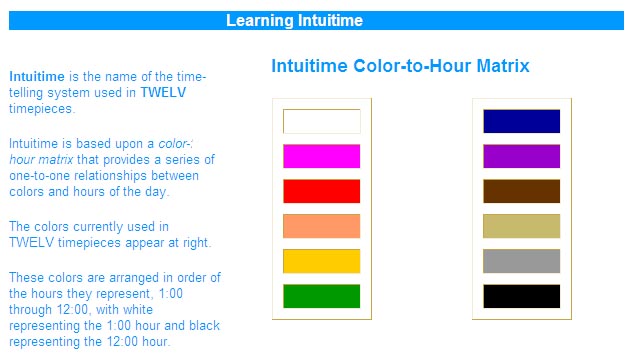
TWELV time relies upon a series of twelve colors, each of which is uniquely assigned to an hour of the day. A color is displayed during the hour to which the color is assigned. Thus, for instance, during the six o’clock hour, the color green is displayed. Minutes are still indicated by numerical digits, which are set against a background that is the color corresponding to the given hour.

The TWELV time-telling system allows a number of advantages. For instance, holding display size constant, two digits can be displayed at a much larger size than can four digits. Meanwhile, colors can be correctly identified at much longer distances than can individual characters or clock hands. Thus, the new time-telling system offers a readability over greater distances than conventional time display methods allow.

Users do not need have to commit the colors to memory right away: the first wristwatch based upon the new technology, called the TIKR(TM), will include a manual override feature so that users can view time in conventional digital format simply by touching the screen or a button.

Harrison holds three patents in the field of wearable computing, including wrist-wearable computers, PDAs, telephones and audio players. He is founder of Wearable Computing(R), an Internet portal, and is most known for creation of the Orang-Otang(R) Peel-It(R), a product that serves as both a case and a wrist-mount for consumer electronic devices such as the Palm PDA or the Apple iPod.

A working demo of the invention can be viewed at http://www.twelv.com/demo5.htm.

TWELV | Sample Color-to-Hour Training Image

Snail Mail’s Revenge: New Postal System Allows Physical Mail to Be Addressed to an E-mail Address

(Original article publication date:  June 2, 2006 (Inventerprise))

Details of a new postal mail system have been disclosed today, revealing a service in which so-called “snail mail”—regular postal mail—can be sent without any physical mailing address. Under the new system, instead of using a traditional physical mailing address (name, street, city, state, zip), a sender simply applies an e-mail address (e-mail protected from spam bots) to an envelope, affixes the correct postage, and deposits the envelope with a postal carrier. Thereafter, the postal carrier hands of the envelope to a third-party service provider, which provider in turn finishes processing the envelope.

Multiple delivery scenarios are possible. In one embodiment, the intended recipient is contacted by e-mail and asked for a delivery preference. In another embodiment, the envelope is simply delivered to the registered owner of the domain name used in the e-mail address; the domain name owner then forwards the envelope to its final destination, if necessary.

Postage required for use of the new service is expected to cost three times the regular first-class mailing rate for an envelope, or two times the regular rate for a postcard.

The new service has not yet been approved by the United States Postal Service, although the creators are seeking approval for launch of the system in the United States before pursuing launch in other countries.

A company representative expressed some hopes for the future of the service today, saying, “We expect this service to simplify people’s lives by eliminating the need for maintaining a physical address book. Just keep up with someone’s e-mail address, and you are good to go.”

If approved by the United States Postal Service, a pilot program could be launched as early as 2008.

—30—

Comment:  This system is part of the Alternative Address Shipping/Courier System.