Identifying your goal as an animal rights activist: Five tiers

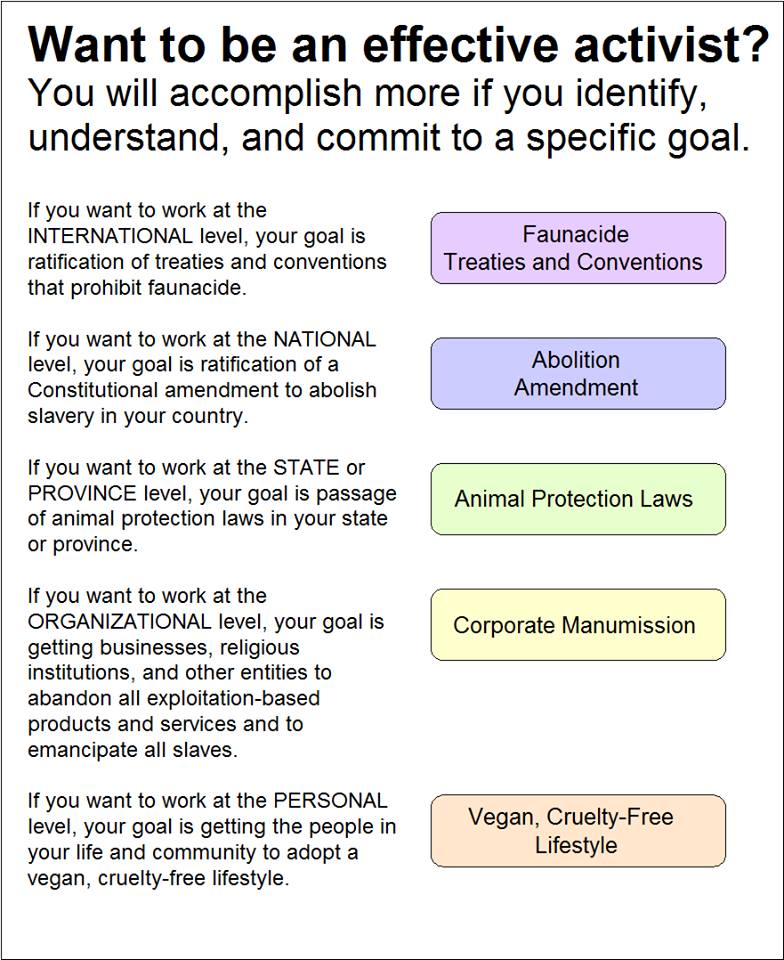
Many animal rights activists and organizations don’t even have a specific goal in mind.  Just ask them!  Most will be able to articulate a strong feeling that something is wrong and a strong desire to fix it.  But many will not be able to describe what that fix is or how that fix actually gets done:-/  This lack of focus is holding back the movement in a big way, in my view.

Here’s a simple chart aimed at helping activists focus their work on a specific, concrete goal.

Effective animal rights activism | faunacide convention, abolition amendment, animal protection laws, corporate manumission, vegan and cruelty-free lifestyle and life choices

Victory at the first three levels will represent the climax of the current animal rights movement; thereafter, the movement’s focus will shift from law-making to law-enforcing.

The latter two tiers represent the means whereby demand for cruelty-based goods and services is eliminated; such elimination undermines the financial viability of cruelty-based activities, thereby setting up the conditions necessary for victory at the former three tiers. Pick your favorite tier, and make things happen!

#animalrights #animalliberation #vegan

—30—

(Original publication date:  Sept. 6, 2015 (FB))

Faunacide convention – 9/4/15 draft

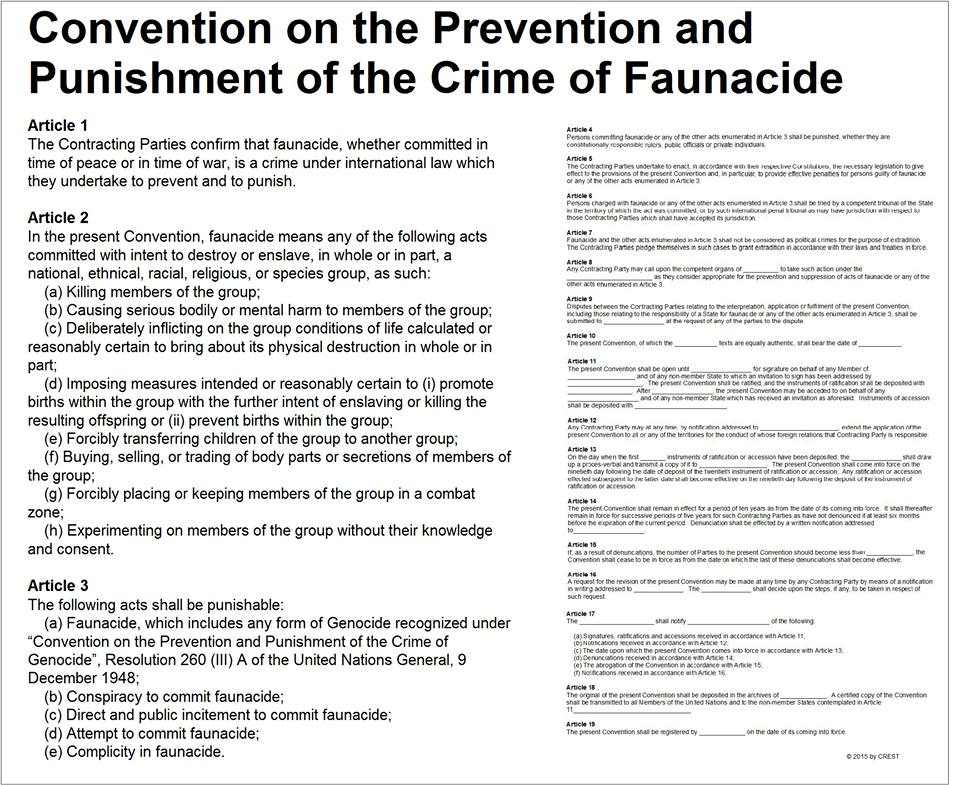
Here’s the September 4, 2015, draft of the Faunacide Convention. Having this language in place gives the international animal rights, protection, and liberation movement a very specific, well-defined target.

Faunacide Convention | Sept. 4, 2015 draft

NOTES: The key substantive provisions appear in the first four articles. Although adhering closely to the text of the United Nations’ Genocide Convention (1948), this draft leaves institutional identification spaces blank so that any group of nations can agree to it, with or without the UN.  That said, bringing the Faunacide Convention into force through the UN will be ideal.

#faunacide #faunacideconvention #environment

—30—

(original pub date: Sept. 4, 2015 (FB))

Faunacide Convention: Drafting with pre-existing Genocide Convention language

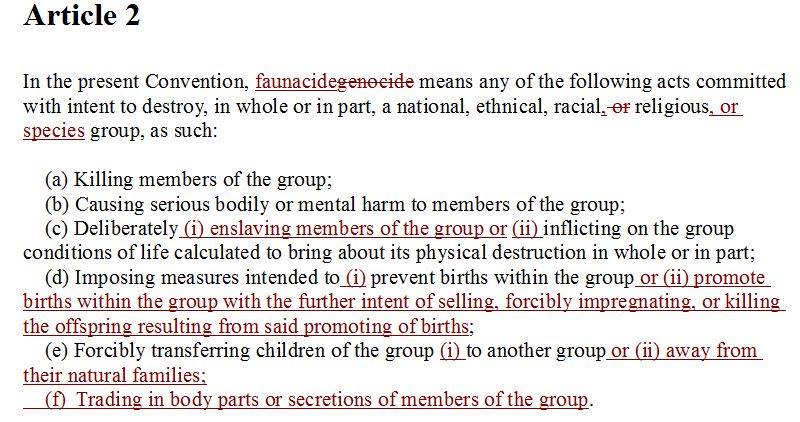
It looks like the Faunacide Convention could simply re-use the existing language of the 1948 Genocide Convention in its entirety with but a handful of changes, mainly to Article 2. Adhering to the structure already in place will make it easier for people to understand and embrace.

Here’s a first draft of such a revised Article 2, with changes tracked. Please feel free to send along any language suggestions!

Faunacide Convention | initial work

(Original pub date:  August 24, 2015 (FB))

American Abolitionist flag design

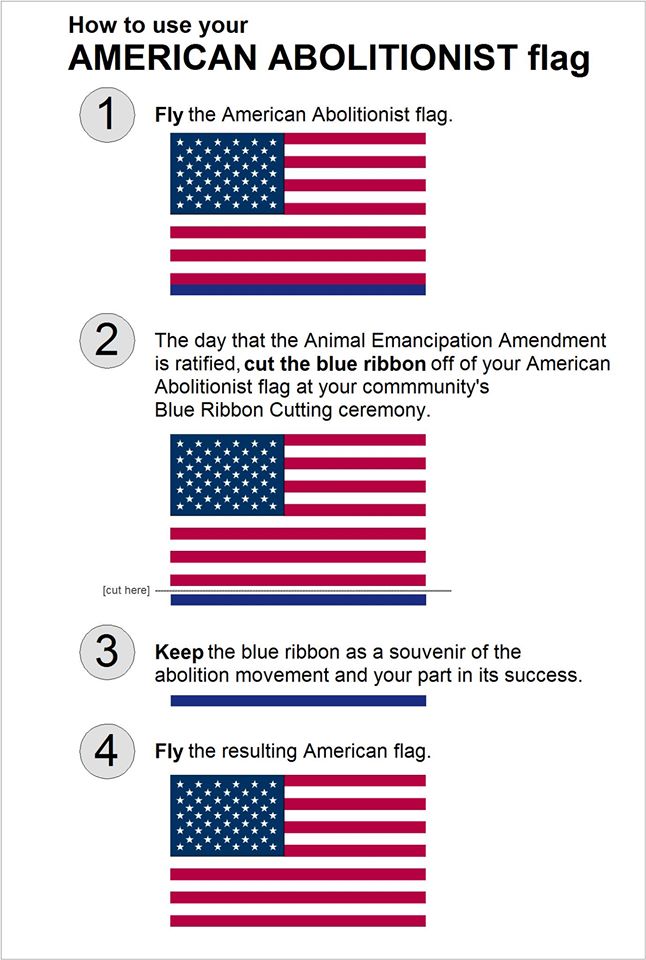
Version 2: Excited about this version because it is participatory. Provides a specific, daily, visual reminder of the goal as well as a ceremony to celebrate and commemorate accomplishment of that goal.

Abolition | American Animal Emancipation flag

NOTE: We should be able to apply this same technique to other countries’ flags without much trouble so that abolitionists worldwide can show their solidarity with each other. Same technique–using a pink or rainbow ribbon–can also be applied for the Equal Rights Amendment II.

#abolition #emancipation #abolitionamendment

—30—

(Orginal pub date:  Aug. 11, 2015 (FB))

Special Challenges for Modern Abolitionists: Part 6

 
Preface:  This article is the sixth installment in a series discussing obstacles to abolition—the ending of all slavery—that movements for proto-abolition—the ending of human slavery—did not have to face.

A precedent problem

Another serious obstacle that an abolition movement faces but which is not faced by a proto-abolition movement is the precedent problem:  while human slavery has been instituted and then cast off many times throughout history and in virtually every region of the world, full abolition has never yet been achieved.

Ancient societies from the golden age of Egypt to the golden age of Greece included slaves. Initially, many of the slaves were formerly the free members of a neighboring society that became enslaved when they lost a war with the enslaving society. After the initial conquest, however, the descendants of captured people were then born into slavery, such that a “slave class” of humans came into being, sometimes lasting for hundreds of years and comprising entire geographical regions. An extreme example of this far-reaching “slave class” and “slave region” phenomenon was that of the Helots, who were an enslaved people that reportedly outnumbered their oppressors in Sparta by more than ten to one.

But even the enslavement of the Helots at the hands of the militarily powerful Spartans came to an end, and human slaves have, at different times and in different places, managed to cast off their chains around the world and throughout human history. These many historical precedents have, in turn, served to guide, encourage, reassure, and motivate proto-abolitionists who came later.

Unfortunately, abolitionists do not have the benefit of such precedents for freeing the animals. To the best of my knowledge, no human society has ever abolished slavery beyond that of homo sapiens. Yes, some individual animals have been treated well by their human captors. Some dogs and cats, for instance, certainly appear to live happy, healthy, care-free lives in a human home. And other animals have just been left alone for the most part, such as deep-sea creatures or other animals who live in places that have so far remained relatively free from human invasion.

But, notwithstanding these fortunate individual cases, the stark social and legal reality has always been throughout human history that animals were considered by humans to be “property” or “propertizeable,” i.e., if one could capture or kill an animal, one owned that animal or her rotting corpse. Modernly, a handful of animal welfare laws have been enacted to prohibit a few egregious practices of animal abuse—cockfighting, for example. But abolition of slavery and emancipation of other animals are not, to my knowledge, even on the radar screen of most human societies.

The fact that full abolition has never been achieved, anywhere, anytime, should not discourage us. Many events that once seemed impossible have eventually come to pass. But acknowledging the special challenges faced by a full abolition movement will hopefully help to inoculate modern abolitionists against some of the burnout, frustration, and fatigue to which they may otherwise be susceptible.

A look ahead…

In this “Special Challenges” series, we’ll explore additional ways in which proto-abolition or proto-emancipation movements differ from abolition and emancipation movements.  If you have comments, suggestions, or contributions, please feel free to send them along.


(Original article pub date:  11/29/13 (FB); 12/3/13 (EthicalVeganism))

Laguna 1
Laguna 1

Delicense, Arrest, Prosecute, Convict: The Four-Step Program for Eliminating Vivisection

DAPC: Enforcing Cruelty Laws against Vivisectionists

(Original article publication date:  May 7, 2011 (Cruelty-Free))

When most people see animals being tortured, they recoil in horror. But vivisection has nonetheless survived through the massive dollars and influence that universities, pharmaceutical companies, and medical lobbying groups wield.

In an effort to rally resources to stop animal torture, here’s a proposed acronym:  DAPC.

DAPC stands for “Delicense, Arrest, Prosecute and Convict.”  These are basically the four steps that need to be taken to eliminate vivisection. Specifically, “doctors” who torture animals must be stripped of their medical licenses.  Obviously, torture is not part of the healing profession and is fundamentally contrary to the vows to which legitimate medical professionals adhere. Those who commit vivisection must then be arrested, prosecuted, and convicted for felony animal abuse.

Thus, the project in whole would be called “DAPC: Vivisection.”  Just a thought.  Here’s a little graphic that you are free to use for any anti-vivisection purpose.

Vivisection
Vivisection

Invention Code Name: Uncommon Law™

Snapshot:  Uncommon Law™ Universal Judicial Opinion Entry Software Forces Judges to Be Logical

(Original article publication date:  July 15, 2008 (Inventerprise))

Problem

Common law judicial opinions have no set form or style (except that they be in English), and they are required to meet no minimum standards for quality—or even validity.  This free-form, free-wheeling approach to law evolved hundreds of years ago as an expedient measure in less-enlightened times.  And it’s time for it to go.

Solution

Uncommon Law™ software eliminates the possibility of long-winded, unnecessary rambling (the lawyers tell us they call that “dicta”) and of fallacious reasoning as follows:  a judge logs into the Uncommon Law website and enters the case number and other identifying information. He then enters conclusion and premise data that go to make up his argument into the proper field. As many fields as necessary can be used, but each entry should include only one premise or conclusion.

Result

In this way, the logical validity of a judicial opinion can be relatively easily reviewed for errors—perhaps even automatically reviewed for certain simple errors.

—30—

Comments:  This PeopleChase database product is based on the Universal Judicial Opinion system.

Over-Laws | Even Higher than the Supreme Law of the Land

(Original publication date:  April 27, 2007)

Every law student knows—or had better know in time for the bar exam—that the Constitution is the supreme law of the land, meaning, that no law can conflict with the Constitution and still be deemed valid. That is the case here in the United States, and virtually every other country has some document or body of law that is treated as supreme in that country. In short, laws of lower priority (local laws, for instance) must yield to the supreme law of the sovereign nation. Meanwhile, foreign laws have even lower status, namely, no effect at all; the law in France does not apply to me, unless, of course, I go to France or become a French citizen.

The discussion of supremacy could end there and, typically, it does. But, in fact, there are laws that trump even the supreme law of the land, and there are laws that apply in every country, transcending all national boundaries, regardless of sovereignty.

Chief among these “over-laws” are the laws of nature. We could pass a constitutional amendment saying that “Gravity shall not apply in Massachusetts” or “All citizens over the age of 18 shall be invisible.” But these “supreme” laws would in fact be void; they would have no effect. When Nature and the Constitution square off, Nature wins.

Fair enough, one might say. There is no need to belabor the obvious. End of discussion.

But the discussion actually does not end there either. When applied in advance (prediction) or after the fact (reflection) in the imagination of a person, the laws of nature have a different name: logic. Yet the supremacy of the laws of nature remains.

For instance, imagine an individual who is accused of murdering someone else. But the murder in question occurred three years before the accused was born. The laws of nature, in such a case, would prevent the accused from being the actual murderer.

In a court of law, considering the crime after the fact, we would apply the laws of nature by saying that to convict someone of a crime that, under the laws of nature, he or she could not have committed “would not make sense”; in other words, it would be “illogical.” Specifically, it is illogical for an effect to precede its cause.

While one flows from the other, there are some major differences between logic and the laws of nature. Perhaps most importantly, the laws of nature cannot be ignored in the present. Gravity works, whether we acknowledge it or not. Our opinion is irrelevant to the functioning of the laws of nature.

But when considering the past or the future, it is far too easy to forget the laws of nature or to misapply them, i.e., to be irrational, to draw illogical inferences. We can easily imagine scenarios that are, while imaginable, impossible. We can imagine, for instance, that a person traveled back in time so as to commit the murder that happened three years before he or she was born. We can imagine a perpetual motion machine. But imagining such things does not make them real.

Misapplying the laws of nature in reflection or prediction is a human error. When we make such errors, grave injustices can be committed. Innocent people are burned at the stake; perpetrators go free; plaintiffs find no relief. Nonetheless, the laws of nature remain supreme and govern in every nation, as does their lieutenant in the minds of men and women, logic. It is we who forget this fundamental supremacy at our peril.

Corporations | Have Your Cake—and Let Someone Else Pay for It

(Original publication date:  April 2007 (ePoet))

Most modern business transactions involve at least one corporation, limited liability company or similar entity. When originally invented, the corporation was permitted only in very special circumstances, because its inherent and enormous dangers were regarded with awe and trepidation. Now, the corporation is omnipresent in our society, but its dangers—still fully present—have been forgotten.

Both the intent and the effect of a corporation is, above all else, to allow participants in an activity to enjoy the fruits of the activity without having to bear the full costs associated with it, specifically, liabilities incurred in the process of conducting the activity. But the costs don’t just disappear. Somebody does bear those costs: everyone else. The people around the corporation—contractors, tort victims, etc.—bear the burdens that would otherwise fall on those who are protected by the corporate shield.

It’s hard to name other instances in our society in which we allow people to have their cake and eat it too, or, phrased more accurately, to have their cake while someone else pays for it. But this is exactly the purpose and result of transacting business through a corporation. It’s equally hard to articulate why we would want a system in which one person gains what others purchase.

Nonetheless, the corporation actually institutionalizes the very externality and free-rider problems that economists teach us to avoid, the same “moral hazards” that legal scholars urge us to minimize.

From both an economic perspective and a moral perspective, the rise of the corporation will go down as one of the most destructive legal developments in recent centuries. Our descendants will reflect upon the many laudable legal advances of the late second and early third millennia, such as the abolition of slavery and universal suffrage, and they will wonder how, amidst such progress, the corporation pandemic was allowed to run unchecked for more than a century while the earth and its inhabitants were abused, contaminated, depleted and destroyed with the impunity afforded by a profoundly bad idea.

Apologists for the corporation will point out that the modern corporation has some desirable qualities, such as shared ownership and unlimited longevity. But these virtues are completely severable from and can be accomplished without limiting liability and are therefore no justification for such limitation.

Others will argue that limitation of liability encourages people to pursue activities they would otherwise not pursue. To which argument the rebuttal is simply, “Exactly!”