UVA Lawyer has run a review of Plutonomics: A Unified Theory of Wealth. The author of Plutonomics is a graduate of the University of Virginia School of Law.
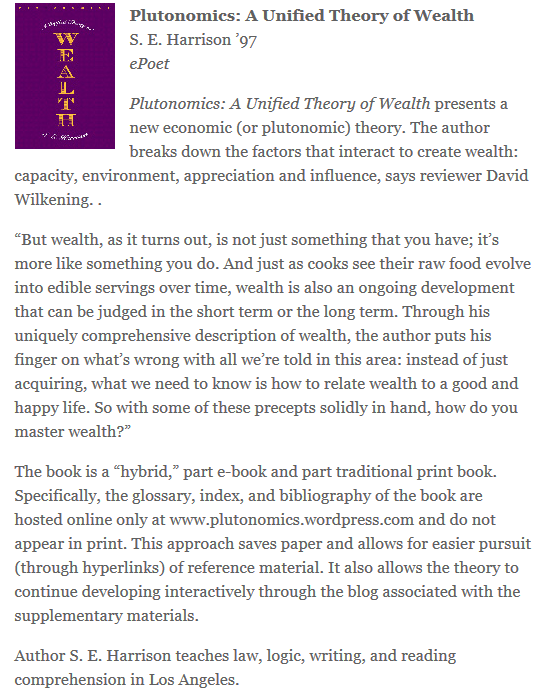
UVA Lawyer has run a review of Plutonomics: A Unified Theory of Wealth. The author of Plutonomics is a graduate of the University of Virginia School of Law.
(Original publication date: April 2007 (ePoet))
Most modern business transactions involve at least one corporation, limited liability company or similar entity. When originally invented, the corporation was permitted only in very special circumstances, because its inherent and enormous dangers were regarded with awe and trepidation. Now, the corporation is omnipresent in our society, but its dangers—still fully present—have been forgotten.
Both the intent and the effect of a corporation is, above all else, to allow participants in an activity to enjoy the fruits of the activity without having to bear the full costs associated with it, specifically, liabilities incurred in the process of conducting the activity. But the costs don’t just disappear. Somebody does bear those costs: everyone else. The people around the corporation—contractors, tort victims, etc.—bear the burdens that would otherwise fall on those who are protected by the corporate shield.
It’s hard to name other instances in our society in which we allow people to have their cake and eat it too, or, phrased more accurately, to have their cake while someone else pays for it. But this is exactly the purpose and result of transacting business through a corporation. It’s equally hard to articulate why we would want a system in which one person gains what others purchase.
Nonetheless, the corporation actually institutionalizes the very externality and free-rider problems that economists teach us to avoid, the same “moral hazards” that legal scholars urge us to minimize.
From both an economic perspective and a moral perspective, the rise of the corporation will go down as one of the most destructive legal developments in recent centuries. Our descendants will reflect upon the many laudable legal advances of the late second and early third millennia, such as the abolition of slavery and universal suffrage, and they will wonder how, amidst such progress, the corporation pandemic was allowed to run unchecked for more than a century while the earth and its inhabitants were abused, contaminated, depleted and destroyed with the impunity afforded by a profoundly bad idea.
Apologists for the corporation will point out that the modern corporation has some desirable qualities, such as shared ownership and unlimited longevity. But these virtues are completely severable from and can be accomplished without limiting liability and are therefore no justification for such limitation.
Others will argue that limitation of liability encourages people to pursue activities they would otherwise not pursue. To which argument the rebuttal is simply, “Exactly!”
(Original publication date: April 13, 2007)
If you ask a friend to describe the essence of morality or ethical behavior, he or she will probably list a number of personality traits: unselfishness, courage, commitment to ideals and values, patience, willingness to forgive, and similar qualities. Certainly, in many religious faiths and philosophical systems, personality traits are the focus: the Christian Beatitudes, for instance, praise meekness, purity of spirit, and peacefulness, while the Noble Eightfold Path of Buddhism emphasizes honesty and detachment.
Against such a backdrop, I am willing to bet that almost no one, when asked, “What is morality?”, would reply, “Good logic skills.”
Logical ability simply does not get factored into discussions of morality, neither in religious nor philosophical nor politically correct circles, at least those to which I am privy. Personality, not processing power, is what we believe to be the heart of morality.
But I think that the omission of reasoning skills from the landscape of morality is a mistake. In fact, it is not difficult to demonstrate that bad logic and bad acts — morally bad acts — often go hand in hand.
Looking into the history of a particular instance of slavery or genocide, we often find an entire network of scientists, philosophers, writers and speakers who laid the foundation. They did so through clever, manipulative but logically untenable theories and “discoveries.” The crimes against humanity committed by Nazi Germany, for instance, were in large part made possible by widespread dissemination of specious arguments about German racial superiority.
A person armed with strong logic skills sees through such garbage. But someone without sufficient reasoning skills is easy prey for pseudoscientists and demagogues.
The relationship between bad logic and immorality, however, is by no means limited to grandscale, social and cultural events and institutions. Personal acts of immorality are also committed by those whose primary “moral” flaw is that of having poor logic skills. Child abuse, spouse abuse, elder abuse and animal abuse are oftentimes predicated upon a genuine but irrational belief in the mind of the perpetrator that the abuse is “good for” the victim. In such a case, the failure may not be so much one of personality as it is one of intellectual ability, in particular, reasoning skills.
The relationship between bad logic and immorality becomes much more visible in the field of law. In particular, when lawyers, judges and lawmakers make logical errors, the results are quite dramatic: people lose their rights, their freedom, and sometimes even their lives simply because someone else can’t reason well.
If one’s irrationality hurts no one else, it’s not a big deal. But when one person suffers actual harm as a direct result of someone else’s poor reasoning skills, the latter’s rational failure is, to me, immoral, perhaps as immoral as any failure arising out of a personality trait.
(Original article date: November 23, 2006 (ePoet))
California-based publisher ePoet(R) announced today the publication of Plutonomics: A Unified Theory of Wealth, a new non-fiction book by S. E. Harrison. As the title suggests, Plutonomics may be the first modern theory to capture all manner of wealth phenomena—from money and property to citizenship and reputation—in a single conceptual structure.
“We are very excited about bringing the Plutonomics project to fruition,” commented marketing director Rebecca Nelson. “Both defenders and detractors should find it an enjoyable literary journey.”
Embracing an unusual format by California layout artist Mike Ng, Plutonomics consists of 77 chapters, with each chapter appearing on a single right-side page. The left-side pages provide illustrations, definitions and “quotes for comparison”—ranging from Shakespeare to Marx, Pavlov to Aristotle—that offer an intellectual context for the right-side text. This format, in catering to the sound-bite generation, has garnered favorable comments from reviewers:
“Innovatively designed… [for] the busy reader,” noted Ari L. Noonan of The Front Page. “Definitely worth your investment,” he continued.
In keeping with its modern tone, Plutonomics also provides an index, glossary and bibliography via the World Wide Web rather than including them in print. The electronic supplementary materials appear on a Plutonomics blog site hosted by Word Press, where users can also explore the origins of the term “plutonomics” and follow hyperlinks to works of economics, finance, psychology and philosophy cited in the book.
“I guess Plutonomics is really a ‘hybrid’ book: it’s part e-book and part regular print book,” Nelson continued. “We thought this approach remained consonant with the message while also giving readers the best of both a ‘sit-down’ book and a blog.”
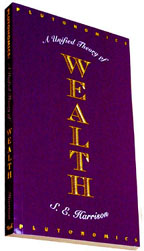
Featuring a foil-embossed cover of gold on purple by Los Angeles designer Christopher Tjalsma, “Plutonomics” cuts a figure as striking as its content. And for easy readability, New York-based illustrator Jonathan Klemstine has turned sophisticated content into simple, easy-to-follow diagrams. Meanwhile, back cover comments from businesspeople nationwide convey some of the excitement surrounding the new release.
Plutonomics: A Unified Theory of Wealth is available through Amazon.com (ISBN: 0-9776420-0-3) as well as through plutonomics.com.
ePoet(R), the Bard of Business(TM), is a California limited liability company providing writing services to the business and technology developer communities.
 Biographer
You must be logged in to post a comment.