Identifying your goal as an animal rights activist: Five tiers

Many animal rights activists and organizations don’t even have a specific goal in mind.  Just ask them!  Most will be able to articulate a strong feeling that something is wrong and a strong desire to fix it.  But many will not be able to describe what that fix is or how that fix actually gets done:-/  This lack of focus is holding back the movement in a big way, in my view.

Here’s a simple chart aimed at helping activists focus their work on a specific, concrete goal.
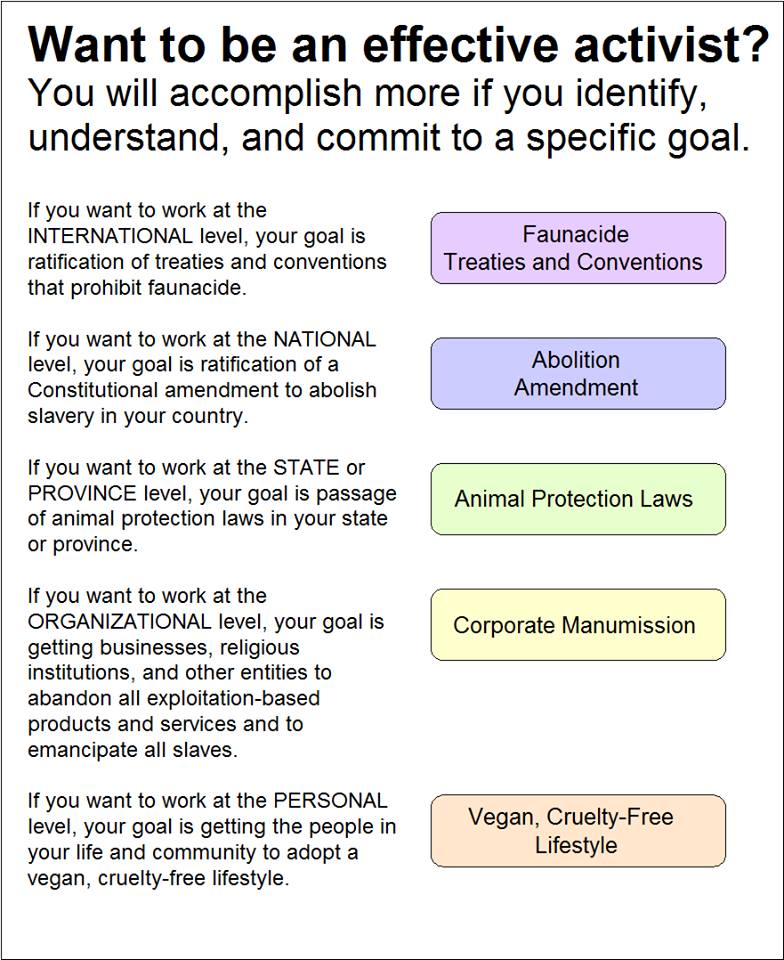
Effective animal rights activism | faunacide convention, abolition amendment, animal protection laws, corporate manumission, vegan and cruelty-free lifestyle and life choices

Victory at the first three levels will represent the climax of the current animal rights movement; thereafter, the movement’s focus will shift from law-making to law-enforcing.

The latter two tiers represent the means whereby demand for cruelty-based goods and services is eliminated; such elimination undermines the financial viability of cruelty-based activities, thereby setting up the conditions necessary for victory at the former three tiers. Pick your favorite tier, and make things happen!

#animalrights #animalliberation #vegan

—30—

(Original publication date:  Sept. 6, 2015 (FB))

Distinguishing abolition, proto-abolition, emancipation, and manumission

Four words explained

Animal rights activists and ethical vegans are increasingly using the word abolition, but this growing popularity appears to be accompanied by some confusion about what the word actually means.  This article aims to serve as a quick, informal guide to the meaning of this word, abolition, vis-a-vis three related words:  emancipation, manumission, and proto-abolition.

Emancipation is the freeing of one or more actual living beings from slavery.  Emancipation does not happen to a legal system; rather, emancipation happens to an individual, living creature.

Example:  Before emancipation, Bill is a slave; after emancipation, Bill is no longer a slave.

Manumission is a subset of emancipation.  Specifically, manumission is the freeing of one or more actual living beings from slavery by the slaveholder.

Example:  Jane is the “owner” of Bill, a slave; one day, Jane decides to release Bill such that Bill is no longer a slave.  That event—the freeing of Bill by Jane—is an instance of manumission.

Abolition is the dismantling of the legal institution of slavery itself.  Abolition does not happen to an individual, living creature.  Abolition happens to a legal system.  Specifically, the given sovereign abolishes the institution of slavery.

Example:  Before abolition, Country X has a legal structure that allows slavery; after abolition, Country X’s legal structure does not allow slavery.

Proto-abolition is the dismantling of the legal institution of human slavery but not of all slavery.  Like full abolition, proto-abolition happens to a legal system, not an individual.

Example:  Before proto-abolition, Country X has a legal structure that allows human slavery; after proto-abolition, Country X’s legal structure does not allow human slavery but still does allow slavery of other species.

deathline
deathline